

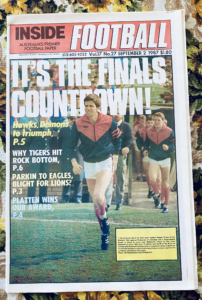
The finality of finals & all things final…
Nigel Dawe
THERE is something about the month of September, and absolutely one hundred times over, when those Demons of ours make the cut. The cut that makes us a part of that dream state we call ‘the finals’. Albeit the final four weeks of the season, in all its wish-woven drama and colour.
My attention always turns to the past though, to those that have gone before us, and not just those that have played the game we love, but games ‘per se’ right back to ancient Rome. I can’t help but think that if we were to bring a citizen from antiquity back to life to watch what we call “sport” in this day and age, they’d be puzzled. Try telling said individual that our key forward has just been rubbed out for three games because he ‘accidentally’ felled an opponent.
Don’t get me wrong, society has improved in so many ways, but to our ancient fan, who went to the Colosseum so as to see fierce combat of the most unflinching kind; being stood down for accidental contact with an opposition player, would be utterly inconceivable. And as a result, they may well have yelled: ‘Dum vivimus, viviamus” – or “While we live, let us live!”
The Roman word for gladiatorial fighting was “munera” (which meant a duty, or gift offered to the dead in the form of brutal armed combat). At best what they’d see today at the MCG would be referred to as “ludi”, or a term that was used for shows and public games. Very light entertainment might even be the most apt way to describe what we see, as spectators today.
It is also quite eerie to think that our modern-day word “arena” comes from the old Roman word for “sand”, which lined the surface of their stadiums. So, it could be aptly considered, that the ghost of many an old gladiator more than prowls the boundary line and fringes of our loyalties and fascinations.
That said, Saturday night will become the 43rd postseason we’ve been a part of, and the 95th time a Melbourne side has entered the finals cauldron, on 54 of those occasions our team have left with a win, and twice with a draw. Steven King will also become just the 11th coach to take our side to a final, out of the overall 35 people that have stepped up since Alex “Joker” Hall first assumed the role as head coach in 1907.
At the top of the ‘pointy end’ of the coaching tree at Melbourne is Norm Smith, a club icon who coached the side in 23 finals matches (for 16 wins, and 6 premierships). The next best September practitioner for the Demons was Smith’s own coach, “Checker” Hughes – a man who called the shots in 18 finals matches (for 11 wins, and 4 premierships in total).
We’ve only played the Blues nine times in a final before (winning six of them), and the last time we met up in such surrounds was in 2023, which saw them win by two solitary points – it was also our last September outing. That final was the fourth in succession which our team had lost (being the first time a Melbourne side had ever bowed out of two consecutive postseasons, in straight sets) after having won the premiership in 2021.
But those are just the numbers, the figures that rise and then settle on the unchangeable pages of history, referred to and known mostly only by fans. Players and coaches on the other hand, are far more concerned with the cut and thrust of the here and now. Because once that opening siren sounds and the ball is bounced, old stats, scores and facts mean absolutely nothing – entire ledgers are swiped clean in seconds, clearing the way for the expanse of fresh new accounts.
That some things never change, albeit ever-pertain to the ‘white heat of battle’ in finals, our first coach Alex Hall advised (in 1946) long after he’d exited the fray: “Try to understand where the player ahead of you wants the ball, so that he can give his best. Try to help the man who must take delivery of the ball from you… Always remember that the speed of a ball properly kicked will outstrip the fastest player yet produced. So, kick the ball – don’t run with it. Conserve your energy and serve your side better. Beat your opponent in the race for the ball. Get clear of him, then drive it on to a team-mate. That is winning football.”
A style of football that has stood up, and proven itself for Melbourne, many times over.

 Follow us on twitter
 Join our facebook group